Garden Valley Vegetable Growers Ltd.
Garden Valley Vegetable Growers: Rooted in Family, Growing for the Future
By Serena Gray-Withers May 22, 2026
At Garden Valley Vegetable Growers (GVVG), farming is more than a business — it’s a family legacy that has grown steadily across generations, grounded in hard work, shared values, and a deep connection to the land.
The farm’s journey into potatoes began in 1968, when the operation first transitioned into processing potatoes under the leadership of Peter Loewen’s father. A few years later, in the early 1970s, the family began working with Peak of the Market Ltd., a partnership that would become a cornerstone of the farm’s long-term success.
“Potatoes kind of won the battle,” Peter says with a laugh, reflecting on how the crop ultimately shaped the direction of the farm for decades since.
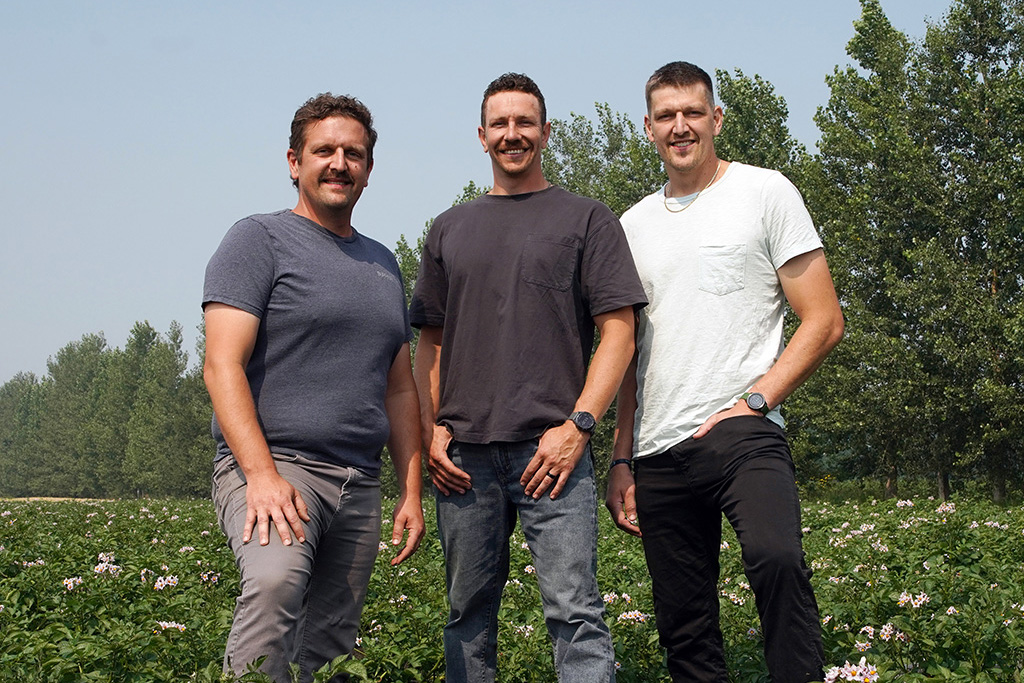
Today, Garden Valley Vegetable Growers is firmly in its third generation, with Peter having guided the farm for the past 25 years. Now, leadership is gradually transitioning to the next generation, Bryce, Devin, and Austin, who are stepping into management roles and helping shape the future of the operation.
“We’re at that stage where the next generation is really getting involved,” Peter says. “It’s exciting to see them take on more responsibility and bring their own ideas forward.”
Over the years, the farm has evolved significantly, both in scale and approach. While potatoes remain the focus, the operation now includes a diverse rotation of crops such as corn, canola, soybeans, and wheat. In 2012, the farm made a key transition to specialize in table potatoes, refining its focus on quality and consistency.
One of the most important innovations has been collaboration. Alongside W.J. Siemens Farming Co., Hespler Farms, and the GVVG partners, these farms are part of a shared wash plant known as the Four Season Potatoes Ltd., where potatoes are graded and washed collectively, an example of growers working together to strengthen efficiency and quality.
Crop rotation and soil stewardship also remain central to the farm’s philosophy. Cover crops such as fall rye are planted after potatoes to help prevent erosion and protect long-term soil health.
“Taking care of the land is a big part of what we do,” Peter explains. “We rely on it every year, so we have to think long-term.”
Despite the evolution of equipment and scale, some traditions have remained unchanged. The farm continues to operate as a close-knit, family-driven business, where most of the work is still done by relatives rather than outside hires.
“We’re small enough in the potato world that it still feels very family-based,” Peter says. “Most of the people working here are family, and that makes a big difference.”
That family-first approach extends into daily decision-making as well. Leadership has transitioned over time, from Peter’s father to Peter himself, and now increasingly to the next generation.
“There’s a lot of trust and freedom to share ideas,” Peter says. “We don’t always agree on everything, but we work through it together. That’s the benefit of family.”
The farm also relies on strong relationships beyond the immediate family, particularly during harvest, when trusted community partners play an important role. These connections help maintain a tight-knit, collaborative working environment throughout the busiest times of the year.
Today, technology plays an increasingly important role in how the farm operates. From soil sampling and GPS-guided equipment to satellite imagery and sprayer cameras, precision agriculture has become a key tool in managing inputs and improving efficiency.
“It’s become much more scientific,” Peter says. “We’re able to be more strategic with where and how we apply inputs, and that helps reduce risk and improve outcomes.”
Even with these advancements, Peter says some of the most rewarding parts of farming remain unchanged.
“It’s the camaraderie and the satisfaction of seeing things come together,” he says. “You put in the time, money, and effort, and then you see it pay off. That’s a really good feeling.”
Looking ahead, the focus is on transition and continuity, as the fourth generation moves further into leadership roles while maintaining the values that built the farm.
“We want to see the next generation fully involved in managing the farm,” Peter says. “That transition is already happening, and it’s important for the long-term future of GVVG.”
As part of Peak of the Market Ltd. (Peak), the farm also emphasizes the strength of collective effort among growers.
“To be part of Peak means you’re working alongside other growers who share the same goals,” Peter says. “It’s about maximizing the return on everyone’s hard work. We’re stronger together. It really feels like one big family.”
Reflecting on the organization’s future, Peter remains optimistic.
“Peak is on a very good trajectory,” he says. “The future looks very bright.”